Showing posts with label landscape. Show all posts

Friday, 12 November 2010

Locative Media and DH Lawrence

Jackie and Jane worked with 28 year 9 students from Eastwood Comprehensive for an intensive day workshop on the DH Lawrence Blue Line trail, student responses, and how this could develop into locative media to augment the trail.

What a fantastic day, everyone worked really well together and tackled a big range of activities with some really creative results. 

Thanks to Miss Hale, head of English, and Miss Lee, at the school on PGCE placement for the valuable preparatory work introducing the students to extracts of Lawrence's writing - in particular the kitchen argument scenes - set in the Breach House, where Lawrence lived from 2-6 years of age.

The day started with quick introductions and a recap of themes identified in the preparatory work: childhood, weather, arguments/aggression, mining/work, uncertainty/suspense, to which Strata added: identity, home.

Then we split into 2 groups to walk parts of the trail and visit in turn the Breach House and the Canyons (where Lawrence played as a child). At each location we asked the students to word-storm 3 words for each of the themes, stressing the importance of their individual response, as we'd return to these word-storms throughout the day. 


On return to school, students paired up and were given one of the themes on which to create an improvised mini-drama, or cameo scene. Using their word-storm responses to each of the locations, they created an 'argument' which might reflect difference of opinion in the responses, difference between the locations, tensions in the theme, or reflections on the original texts. In just 15 minutes some great ideas evolved, and each pair then 'performed' their mini-drama to the rest of the class.


After a full and interesting morning, the afternoon activities tightly focused ideas and responses into paper-based form. 

We discussed Lawrence's poem, Discord in Childhood (1916, from the collection Amores).
The 2 verses follow an ABAB ABBA pattern and contrast inside with outside, touching on other themes already identified.

Each pair then had just over half an hour to workshop their word-storm responses and the actions of their mini-dramas into an 8 line poem, drawing on elements of Discord in Childhood to inform the construction of their poem.
Not everyone completed 8 lines, but there were some fantastic original efforts to develop further in school over the coming weeks.

Meanwhile the next activity focused on the images in the poetry, asking each pair to storyboard their poem, a frame per line, as if to create a short illustrated film.

The considered approach behind this was that students would have started with an in-situ, embodied experience of the world through Lawrence's eyes, overlaying their own response to the locations as young people growing up in the area today. This would distill into a physical drama, creating action- images based on the words and themes of their response. Those actions would condense into words in the form of poetry, which could then easily expand again to consider the framing and imagery to accompany the text. Ideally the combination could then be recorded - participant voices with screenshot storyboard frames, as a series of young people's works based on two of the locations of the Blue Line trail. A natural flow from location through embodied reflection to creative output as text and image in time.  


The final pair of activities were intended to demonstrate the way this creative work could augment the trail using locative media. 
Jackie gave a quick introduction to gps-triggered locative media, the empedia website and the Blue Line Locative Media project development. The project is a partnership between DHLawrence Heritage, IOCT De Montfort University and Cuttlefish Multimedia, funded by MuBu. Paul from Cuttlefish, who was filming some of the activities and creative work for use on the project, explained how empedia will work, demonstrating QR codes as a trigger for media content, and dazzling us with the content coming to life on his ipad and iphone. 

Students were quick to grasp the implications of the technology, and were then challenged in the final activity to think about the challenges of organising routes through the vast amount of data/content that could potentially be 'out there' in the virtual environment or online.

Seven coloured balls of wool represented the themes we had explored during the day. Two high tables represented the two locations, Breach House and Canyons.
Each student was asked to write down their word-storms relating to the theme they had focused on, a word per coloured paper, and to peg them onto the theme (wool) near the location described. 6 words = 6 sheets per person x 28 people = quite a lot of pegs!
Next, using coloured mini-post-its, everyone wrote down key words from their word-storms related to the other themes, and attached these to the growing cats-cradle of tags.

A visualisation of tagged data relating to two locations!
What I hadn't anticipated was that in doing this, 7 new poems had been collaboratively created, one per theme.
Students who had completed poems volunteered to read out their own pair's poem to the class, and then to read the new 'poem' created on that theme by the tags of paper.
Quite a lot of words repeated in the new poems, emphasising the importance of giving your own unique response rather than discussing and sharing word-storms amongst friends. It also emphasised how the students had responded in some similar and some contrasted ways to each theme. Surprisingly the second theme narrated had NO words in common with the first theme. The third theme, again very different in responses, had just one word in common - raising the example that text could be narrated not just in a linear way along the themes, but also across themes, offering more ways for 'users' to explore the 'content' or 'data' according to their own interests.
The final pair chose to recite their own poem with different voices for alternate lines, and reflected this in narrating the new collaborative theme 'poem' by reading tags from each location in turn, gradually moving in to reach the mid-point together. Lots more room for experimentation.... and a great way to visualise the technical context whilst returning to our starting point of the day - themes and word storms, collaboration and individuality.


Jane and I both felt what a pleasure it had been to work with such and engaged and inspiring group of young people and two fantastic members of staff - a real pleasure to go away tired but invigorated and wishing we had a couple more days to work up the material further with the students.
The staff have plans to develop the poetry and the storyboards further with in-school media support, so we look forward to hearing how the work evolves and hopefully to experiencing some of it on location when we next visit Eastwood to walk the trail, empedia app in hand!

Wednesday, 3 November 2010

DHLawrence, Eastwood and the Blue Line Trail

We've been busy planning a day workshop for Year 9 students at Eastwood Comprehensive for the Museums and Locative Media Project with DHLawrence Heritage, De Montfort University, Cuttlefish Multimedia and other partners.

The photos are from Jackie's site visit a couple of weeks ago.

Students are already working on Lawrence texts and researching the trail with Elizabeth Hale, Head of English, in preparation for the workshop. We've got an action-packed day lined up, hope it doesn't rain!


Saturday, 18 July 2009

Soundlines at Interactive Avebury

Today Soundlines had it's first public testing, with mediascapes (and ipaqs and headphones available to borrow) as part of Avebury Interactive, on Avebury Open Day 2009.
It was a good success, with some lovely appreciative feedback.


Thursday, 18 June 2009

Fwd: Living Landscapes - thursday

I tried emailing this from my mobile - but it didn't reach the blog.. so here it is, sorted..
Date: 2009/6/18
Subject: Living Landscapes - thursday

Im at Aberystwyth University for a 4 day, action-packed conference on landscape & environment.
So first thing we learnt how to say welcome in Welsh.. Croeso... And the welsh word for locality, place to which one belongs, locating humanlife in the environment is Cynefin.
George Monbiot gave a moving opening address, with todays climate report an ominous challenge, but stressing the need for us all to engage with climate breakdown as the pervading issue, and using creativity to get peoples prefrontal cortexs waking up from denial, and minds changing.
Then a plenary on 'post-discplinary' exchange, from material science to theatre research and cultural geogaphy.
Next a performance/pesentation/paper from the weeklong body weather residential in snowdonia - bhuto, permeable nature and body/landscape as continuously changing and bringing eachother into being. Nice.
Acoustic landscapes with wildlife sound recordist Chris Watson was great, loved the female cheetah purring. And the amazing mini habitat of flies and vultures inside the carcass of azebra. Freshly killed zebra.
For a bedtime dreaming his 16 min. Installation of 12 hour desert night sounds of the kalahari... I can still 'see' the stars!And inbetween all that was an hour performance of an audio piece for and about the Ancolme valley in lincolnshire. (look s a lot like the somerset levels...)
More tomorrow.... With an early 7am start for performances in the landscape workshop.

Wednesday, 17 June 2009

Whitesheet Soundlines

Sunday, Strata test walks on the hill...


With wonderful old hawthorn tree.

[This is using a pre-release version of mscape, which I was testing out for e-merge.
It's fine playing Soundlines on the ipaqs but a few teething problems running on the HTC phone - appears to rotate the whole map by 90` which was very confusing!]

Apart from the residency of two very large bulls, one in each of the mapped fields, it was a beautiful day to explore the hill discovering sounds and getting a suntan!


Tuesday evening I went back for a solo experience. I love the overlays of rythms and textured sounds, intensifying with the contours of the land. Moving slowly the sounds and patterns in space start to connect - a feeling of absence when I left the rich sounds of the round barrow. Quickly enchanted by discovering a tiny band of flute, that blows in the wind. The wind catching the headphones - sounds inside or out? Recapturing the flute, staying very still, a shaft opening up in the space of the landscape, if I stay still the melody uncurls, telling a story of time deep and passed. Then I follow a surface line, traversing the hilltop, crisp and sharp, rattley rythm.. has someone walked here before.. As I follow the sound follows the path. A new area beyond the ditched earthworks. And an invisible sound-mirror of the barrow - sound echoing form, creating a new sense of place, relationship and passing. Walking back I see a cow and calf following an unmarked path. Soundlines connect me as I follow them on my own unmarked path. Soundlines reaching out to the paragliders in the air, to the ripples in the grass, perfumed by orchids. Captivating, enhanced.

Friday, 10 April 2009

media dancescape

Creating sound clips today, based on elemental themes - water, air, fire, earth. Polyrhthms.
Here's an idea: a dance mediascape ....

Dancers in an open landscape
interpreting soundlines through dance
(filmed, watched )

Sunday, 8 February 2009

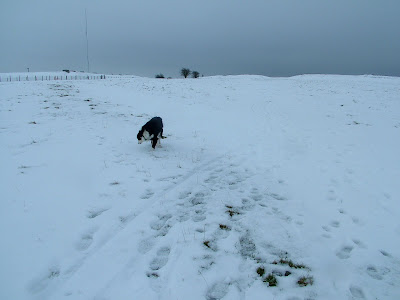
Whitesheet snowlines

In the snow the earthworks stand out prominently - dark lines on the white hill.


Closer up and there are new lines revealed - a diagonal path of higher land.


The ditches have dark tops where the snow has blown clear, and white white fills where one step can take you from a crispy smudge of snow on grass to a couple of feet deep, the wind has evened out the contours of the land!
The round barrow has no snow, and fiery heat emanating from it.
And the centre ring - a nectar like silky soft honeylike feeling of energy swirling, spinning clockwise, rising up and down with rainbows lighting the air.
Close your eyes, listen inside your body - what does the land whisper to you?

Tuesday, 13 January 2009

Squiggles

I am excited by the idea of the trace unfolding as the music plays.

Sometimes I use a music workshop warm up called 'squiggles'. Players pair up, and both draw a squiggle. (- these look very similar to the traces.)
The idea is that you then play your friends' squiggle on your instrument - it's another way of writing music. Responses and interpretation vary a bit as you can imagine.

The traces of our significant journeys across ritual landscapes could be close to geomancy.

It also opens questions of how landscape affects our culture, our language, our vernacular architecture, our music..... perhaps less now than before : time to reconnect?

Friday, 9 January 2009

A breath of fresh air

..is the theme of the spring 09 magazine of the National Trust that came through my letterbox today. Lots about getting kids (and adults) outside to connect with nature, walk and be healthy!
Their article 'Natural Health Service' (pp.20-23) by Dr William Bird, Strategic Health Adviser to Natural England, says:

'Children develop a lifelong ability to connect with nature but only if they are allowed to play freely in streams and woods before the age of twelve.

...Have we drifted away from how we were designed to live?
We need to be restored to our factory settings.

...The Department of health has launched a physical activity plan in which the opprtunities offered by the natural environment are central to getting the whole nation more active. A new scheme has been piloted by london GPs whereby patients are referred to parks and places for outside exercise that may well include Trust properties.'


Another article in the same magazine is about a family of 4 who set out to see 50 of Britain's 100+ mammals, in the wild, in a year. Mammal Magic, by Dominic Couzens (pp. 72-74):

'There was a serious side to our quest too. In the last few years the poverty of Britains' children's relationship to the natural world has become a matter for heightened public concrn. In the summer of 2008 the NT published a survey showing that children, as a whole, are becoming more and more detached from their environment. Only 53% can recognise an oak leaf, and similar numbers fail to recognise common butterflies and birds. Many parents lament this loss.'


The magazine doesn't seem to be online, but here's part of a different NT report
'Nature’s Capital: Investing in the nation’s natural assets'
that has an interesting chapter, page 10, titled:
'The nation needs... access to green space for health'
http://www.nationaltrust.org.uk/main/w-natures_capital.pdf

Thursday, 11 December 2008

Trees and open space in the neolithic landscape : the need for sightlines

Oliver Rackham ( Woodlands; Collins, 2006) is interesting and persuasive on neolithic woodland. He sees any concept as 'wildwood' as belonging to the mesolithic and open to interpretation.  Anything post-mesolithic in the British isles would not be classifable as wildwood.
In the neolithic 'pollen diagrams show a great expansion of non-tree pollens' - coppice and open spaces make room for more pollen bearing species.
'The 'obvious explanation' of the elm decline in the early neolithic period is Dutch Elm disease.

'Monuments such as henges and long barrows involved precise alignments and called for a distant unobstructed horizon.Wide areas of what was later to be chalk downland and heath were already open country.


An open landscape on Down Farm - looking across the cursus towards the place of the midwinter sunset
.